How to make a significant impact by donating clothes
- Martina Cervetti
- Jan 6, 2025
- 3 min read

The reuse of clothes is fundamental, both from an environmental point of view, to counter consumerism and the waste of products still in good condition, and from a social point of view, to offer concrete help to people in need.
In this regard, I have set myself two main goals:
Collecting clothes from close friends for donation (a desire I have cultivated since I was a child).
Conducting a survey to explore the habits related to selling and donating used clothes.
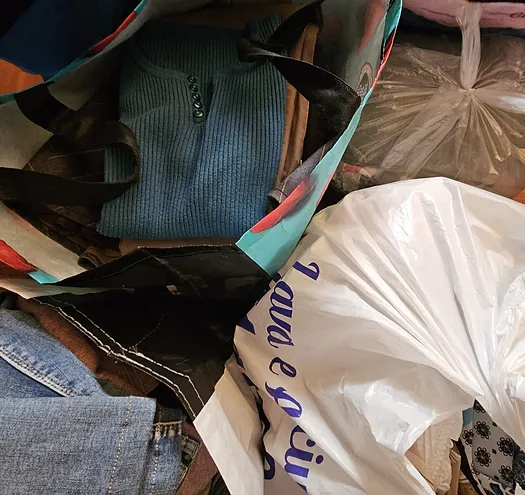
Collecting and donating clothes
I was able to collect about 75 kg of clothes, weighed with a scale to calculate the environmental/social impact through HUMANA's platform. (reference link for the calculator: https://raccoltavestiti.humanaitalia.org/contatori/).
Thanks to this collection, we contributed to achieving important results in terms of sustainability (approximate values):
Planting of 18 trees.
Purchase of 15 school kits.
Purchase of 15 seed kits (soybean, peanut, sunflower).
Avoided 458 kg of CO₂ emissions.
Reduced the use of 45 kg of fertilisers.
Saved 450 m³ of water.
After collecting the clothes, I delivered them to one of the HUMANA collection points in Turin, Via Steffenone 29.
The clothes will then be transferred to the sorting centre, where a team will carefully sort them for best value.
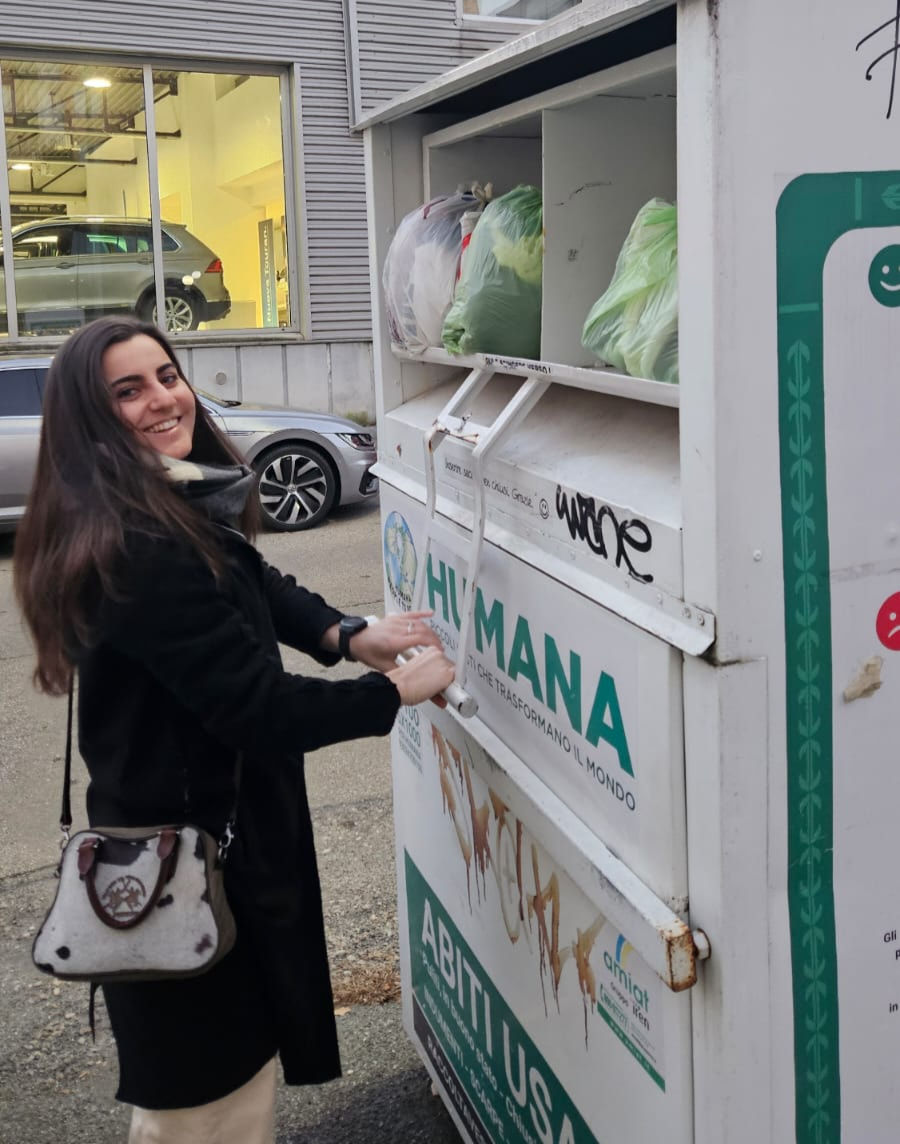
The destinations of clothes donated to HUMANA fall mainly into three categories:
Direct reuse (65.1%): Most of the clothes can be worn again, either in Italy or in the rest of the world. Clothes in good condition, especially summer clothes, are destined for direct reuse in Africa. In Europe, they find new life in charity shops and through the wholesale market.
Recycling for fibre recovery (28.5%): garments too worn out to be reused are processed to recover useful materials.
Energy recovery (6.4%): Only a very small part of the donated clothes is destined for energy recovery.
Thanks to this process, the clothes collected by HUMANA are valorised in a sustainable way, reducing waste and maximising environmental and social benefits.
For those interested, I leave the link to follow the path that donated clothes take: https://raccoltavestiti.humanaitalia.org.
Survey on the buying and donating habits of used clothes
I conducted a survey in Italy to analyse habits related to buying, selling and donating used clothes. I created the questionnaire on Google Forms and disseminated it among friends, family and via the main social networks.
A total of 166 people, residents in any region in Italy, participated, with a 69% female prevalence compared to 31% male. Most of the participants belong to the 26-35 age group (42%), followed by the 18-25 age group (25%) and the 46-60 age group (18%).
Main results of the survey
Donation:
95% of the participants have donated clothes at least once in their life.
Donations are mainly made to friends and acquaintances, to used clothing collection bins and to Caritas.
The prevalent frequency is once a year.
Sale:
55.4% of the respondents have never sold used clothes.
Among those who did sell them, the main channels were online platforms such as Vinted, Subito and Facebook. Again, the prevalent frequency is once a year.
Purchasing:
48.8% have bought second-hand clothes, while 52% have never done so.
Most purchases are made in physical shops or flea markets, followed by online purchases or through friends and acquaintances.
Online purchases are mainly concentrated on Vinted, Subito, Facebook and eBay.
The prevalent frequency is two or more times a year.
Considerations
The survey shows that a high percentage of people donate second-hand clothes, which is encouraging, considering the social and environmental benefits of donation. However, the purchase of second-hand clothes is still uncommon, despite the growth of platforms such as Vinted.
As for in-store sales, the habit of buying second-hand clothes seems to be less entrenched, but there is room for change, especially observing the growth of flea markets and second-hand shops.
Acknowledgements
I would like to conclude by thanking everyone who participated in the survey and the friends who contributed to the collection of clothes and materials.
Every small gesture can make a big difference!
Martina


