Exploring the Humana People to People Center in Italy
- Martina Cervetti
- Mar 30, 2025
- 5 min read


At the end of February, we left to visit Humana Italy in Milan, the Italian sorting center. Meanwhile, the other core group traveled to Madrid to visit the Spanish headquarters.
We spent three intense days at the center, participating in various learning and practical activities.
Humana People to People Italia is an independent and secular humanitarian organization, founded in 1998, committed to promoting solidarity and sustainable development. It is part of an international network that includes various organizations and foundations belonging to the Humana People to People network. Through a wide range of international cooperation projects and social activities in Italy, Humana Italia works to improve the living conditions of people in vulnerable situations. One of the main areas of intervention for the organization is the collection, sorting, and enhancement of used clothing, which, in addition to contributing to environmental protection, generates vital resources to fund social and environmental projects both nationally and internationally.
Day 1: Introductions and Group Division
The first day was dedicated to introductions and interviews between us volunteers and the Humana team. This gave us the opportunity to gain a deeper understanding of how the organization operates and its projects. In particular, we examined how Humana incorporates the circular economy into its process and the management of the clothing supply chain. Afterwards, we were divided into three groups to carry out specific activities in the following days:
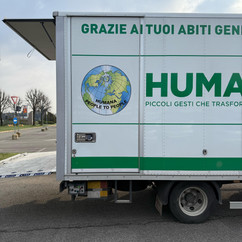
Group 1: Clothing Collection – Two people accompanied the drivers in collecting clothes from the bins in Milan and Monza, starting at 4 a.m.
Group 2: Sorting and Distribution Center – Five people visited the sorting center to understand the entire process, from the arrival of the clothes to the labeling for sale in the stores.
Group 3: Store Visit – One group explored the vintage and second-hand stores in Milan, interviewing customers and analyzing the perception of the Humana brand.



Each group defined a research objective to delve into and present on the final day at the final meeting. Here, you can see the focus of our investigations:
Group 1 investigated the methods of collecting clothes with the vans in the morning and strategies to optimize this process.
Group 2 focused on the current and future profit strategies and maximization within the sorting center.
Group 3 examined the process of determining prices and restocking the stores, managing collections, and assessed customer awareness regarding Humana's supply chain and the funding of projects through the sale of the clothes.
Day 2: Field Analysis
I spent the day with Group 2, which focused on discovering the sorting center. It was an engaging experience that allowed us to see the entire process of garment processing.


The process of sorting/processing the clothes
The clothes collected by Humana's vans are transported to the sorting center and placed on a conveyor belt for the pre-selection phase. Here, they are separated from other items such as toys, bags, shoes, and other fabrics. Dirty or unsuitable clothes are sent for recycling to produce new materials, and a small portion, along with items no longer usable, is destined for energy recovery.
Next, the garments go through an ozone tube for disinfection before entering the main sorting phase. Once disinfected, the clothes are divided by staff into different categories: Tropical mix, Vintage, Winter mix, and Shop mix. A final quality control is conducted randomly by supervisors to correct any errors and train the staff.
At this point, the clothes take different paths:
The vintage items are further selected to maximize their potential. There is a category created based on current fashion trends in specific countries: the "Swedish" fashion, which is shipped to the countries where this particular trend is popular. All vintage items, however, remain in Italy for sale in Humana stores. Due to a lower presence of vintage items after collection, a percentage of them is purchased by other Humana centers in Europe to supply the Humana People to People vintage stores in Italy.
After the selection and quality control of the vintage items, these garments are labeled and priced, ready to be distributed to the Humana People to People vintage stores.
The Tropical mix items, mostly summer clothing, are sent to Africa as donations.
The Winter mix items are sent to Pakistan as donations.
All the "Shop mix" clothes are sent to Bulgaria and other countries, where they are divided into four categories: Cream, Extra, A, and B. Italy then re-purchases category A to restock its second-hand stores.
Day 3: Research Results, Practical Activities, and Visit to the 3C Garden
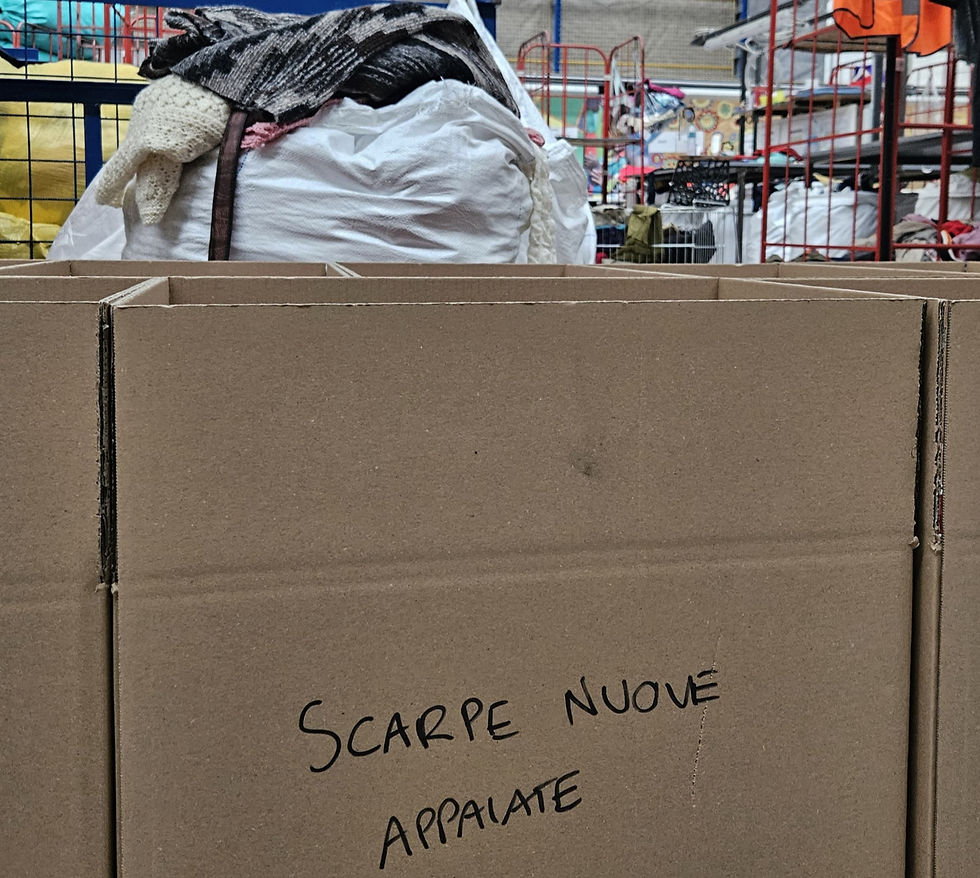
On the final day, we started with practical activities to support Humana's daily operations:
Maintenance of the bins (removal of stickers, repainting, and repositioning labels).
Sorting and selecting fabrics and shoes.
Packaging of bags made from fruit and vegetable waste.
Visit to the 3C Garden
After the practical activity, we visited the 3C Garden, a Humana People to People project focused on ecological urban farming. It promotes sustainable cultivation and self-production, while also strengthening the local community and its social relationships.
Research Results
After the visit to the 3C Garden, each group presented the results of their investigation carried out the previous day.
Group 1: Highlighted that donations are numerous, but despite the instructions on the bins regarding what can and cannot be donated, many people still do not follow the guidelines. Often, clothes arrive in plastic bags that are not sealed, and sometimes they are wet or not properly dried.
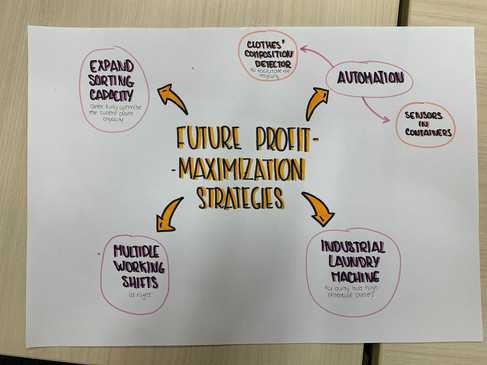
Group 2: In my group, we highlighted the current and future strategies of Humana to maximize the profit/value of the garments.
Here are some of these strategies:
Current strategies:
Safe and quick operations, with an immediate response in case of equipment malfunctions.
Optimization of sales, including items (shoes, bags, toys, etc.) that are donated and/or resold.
Adoption of marketing strategies to follow trends and increase profits.
Future strategies:
Purchase of an industrial washing machine.
Introduction of night shifts.
Expansion of the sorting center.
Installation of sensors to monitor the fabric composition and container capacity.


Group 3: Highlighted that very few people are aware of where Humana's revenue goes and the international cooperation projects that are funded. One possible solution to increase awareness could be the creation of a brochure or a small informational tag that explains the projects, the use of revenue from clothing sales, and the reality of Humana.
As many know, before starting this experience, I organized a clothing donation drive with some friends to donate to Humana (if you're interested, you can read the article: "How to Make a Significant Impact by Donating Clothes" here on the blog). Seeing the entire process up close gave me an even greater awareness of how donated clothes are managed and their social and ecological impact.
It was truly wonderful to meet Federica, our Italian advisor, Karina, president of Humana People to People Italy, and the whole team that guided us with passion throughout these days.
Martina


